FitHelix Science · Nutrition
12 min readWhat Does Protein Do, and Is More Always Better?
Protein does not go straight to muscle — and how much is enough has more than one answer.
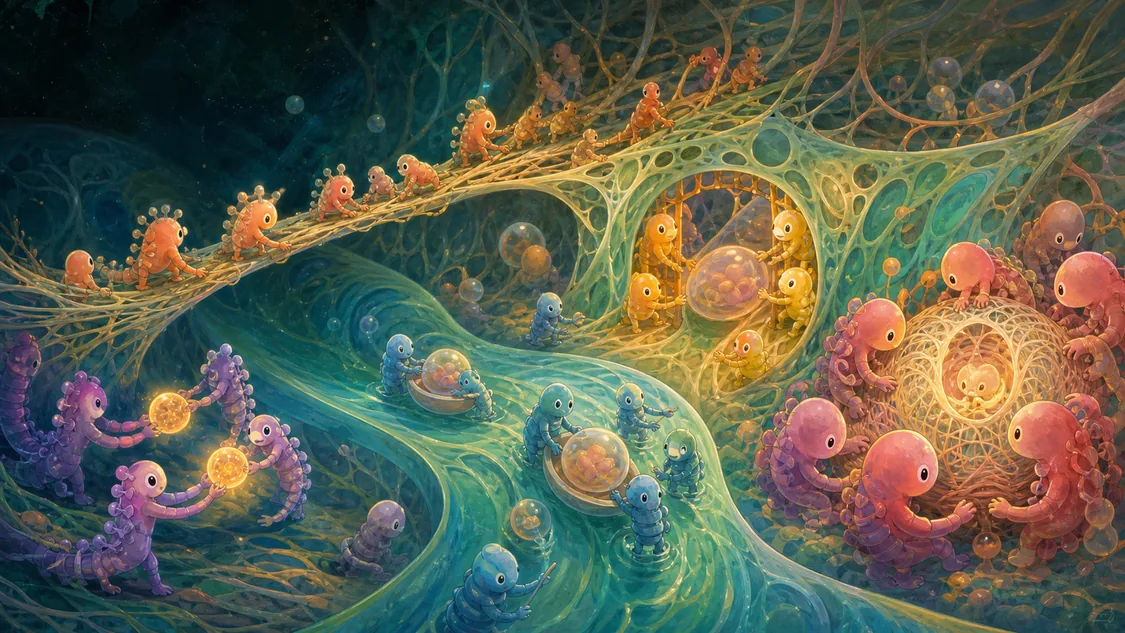
One material, many jobs
This shared workshop is an editorial analogy, not a real organ, cell or complete metabolic pathway.
Before counting grams, follow one bite
Picture a simple plate: rice, vegetables and an egg. Now take one bite of the egg. Before asking how many grams of protein it contains, try a more useful question: after you swallow, where does that protein go?
Muscle is the answer that comes most easily. Gym videos, protein bars and supplement tubs repeat the same picture—a tidy pipeline carrying food protein straight to biceps and quads.
The body has no such pipeline. That bite of egg does not carry a shipping label marked “deliver to muscle.” It first has to be broken into smaller pieces and mixed with amino acids already moving through the body. Only then can those materials be used to build something new, and muscle is just one possible destination.
Protein has to come apart before it can be reused
A protein is a long chain. Each link is an amino acid, and the order of those links helps determine how the chain folds and what it can do. The proteins in egg, tofu and your own tissues are not identical finished products.

Take it apart before reusing it
The long chain, short fragments and reusable pieces show a simplified sequence; real digestion and absorption involve more steps.
In the digestive tract, enzymes cut food proteins into shorter fragments called peptides and into individual amino acids. The gut can then absorb those smaller pieces. Digestion does the cutting; absorption moves the products from the gut into the body. They are connected steps, not two names for the same event.
So a chicken breast does not become a piece of chest muscle. Food supplies raw materials. The body draws on those materials, together with amino acids it is already recycling, to make proteins according to its current circumstances.
Muscle is only one of protein's jobs
After absorption, amino acids join a moving “pool” of available materials. This is not a bag or an organ. It is a useful way for researchers to describe free amino acids in blood and tissues that can enter different reactions.
What does the body make with them? Muscle proteins are one answer. Structural proteins help hold tissues together. Enzymes speed up chemical reactions. Hemoglobin carries oxygen. Receptors on cell surfaces receive signals. Antibodies take part in immune defense. Many hormones are proteins too.
Important does not mean more automatically makes more
Calling protein “muscle material” therefore leaves out most of its working life. But the correction matters in both directions: eating more protein does not automatically create more muscle, more enzymes or more antibodies. Where amino acids go depends on what the body is doing, not on a promise printed on a package.
The body keeps renovating; it does not keep a spare-parts warehouse
Body proteins are not built once and left untouched. Old proteins are continually broken down, new ones are made, and many of the released amino acids are used again. Because of this recycling, the amount of protein the body turns over in a day can exceed the amount eaten that day.
Free amino acids do not have a dedicated long-term storage depot. Amino acids that are not used for synthesis enter other routes. Their nitrogen can be removed and processed into urea, which is eventually excreted by the kidneys. The remaining carbon skeleton can enter energy production or other metabolic pathways, depending on the circumstances.
Do not compress several routes into one myth
That does not mean “all extra protein is peed out.” It does not mean every gram above a magic number instantly becomes body fat either. Recycled body protein, free amino acids, nitrogen in urea and the remaining carbon skeletons are different parts of the story. Many protein myths begin by compressing them into one neat sentence.
Four familiar numbers, four different questions
Ask “how much protein should I eat?” and numbers start flying. A Nutrition Facts label uses 50 g. The adult Recommended Dietary Allowance, or RDA, is 0.8 g/kg/day. The 2025–2030 U.S. Dietary Guidelines give a broad serving goal of 1.2–1.6 g/kg/day. Resistance-training discussions often mention a number near 1.62 g/kg/day.
They can sound like four experts arguing over one correct answer. They are not even answering the same question.
Four numbers, four questions
The FDA's 50 g is a Daily Value: a general reference used on food labels. It helps show how much one serving contributes to a standardized daily reference. It does not measure one person's biological need.
Daily Value on the Nutrition and Supplement Facts Labels.The adult RDA of 0.8 g/kg/day comes from the Dietary Reference Intake framework. It asks what intake covers the needs of nearly all healthy adults within that framework. It was not designed as the “best” number for gaining muscle.
Dietary Reference Intakes - Recommended Dietary Allowances and Adequate Intakes.The newer Dietary Guidelines use 1.2–1.6 g/kg/day as a broad serving goal adjusted for energy needs. That is visibly higher than the existing RDA, but a short public guideline does not turn the difference between two frameworks into a personal prescription.
Dietary Guidelines for Americans, 2025-2030.The number near 1.62 g/kg/day came from statistical modeling of resistance-training and protein-supplementation studies. The participants were training, and the question was whether extra protein could add to the gains from that training. Move the number to every adult's dinner plate, and the question has changed.
A systematic review, meta-analysis and meta-regression of the effect of protein supplementation on resistance training-induced gains in muscle mass and strength in healthy adults.These four numbers cannot be arranged as “minimum, ordinary, better, best,” and none is a personal answer for every reader. Before doing arithmetic on dinner, ask who published a number, which population it describes, and what problem it was meant to solve.
What “more” meant in resistance-training studies
Put the study conditions before the number
A 2018 meta-analysis combined 49 studies involving 1,863 healthy adults. Everyone completed at least six weeks of resistance training. In that setting, protein supplementation added a mean 0.30 kg of fat-free mass (95% CI 0.09 to 0.52) and 2.49 kg of one-repetition-maximum strength (95% CI 0.64 to 4.33), compared with training without the extra protein.
Those are group averages, not a forecast for one person. Fat-free mass is not identical to newly built skeletal muscle. The combined studies also differed in participants' usual diets, training experience, supplements and programs. The stronger stimulus was the resistance training itself; extra protein added a modest average gain on top of it.
The model estimated no further fat-free-mass gain once total intake reached roughly 1.62 g/kg/day. The 95% confidence interval around that breakpoint was wide—1.03 to 2.20 g/kg/day—and the estimate belongs to this training comparison. It is neither a public-health recommendation nor a safety ceiling. The useful lesson is narrower: in a particular setting, more helped on average, but the gain did not keep climbing without limit.
Feeling fuller is not the same as losing weight
Protein often appears in weight-loss claims for two reasons: people may feel fuller after eating it, and the body may spend more energy processing it. Both ideas have some evidence behind them. Neither is a shortcut.
Two average tendencies, not a weight-loss shortcut
In short-term, calorie-matched comparisons, people often report less hunger or more fullness after a higher-protein meal.
Effect of short- and long-term protein consumption on appetite and appetite-regulating gastrointestinal hormones.A review of 10 articles involving 1,079 adults with overweight or obesity found greater fullness or satiety in six of the 10. The studies varied, and the review authors rated the overall evidence as low. An average feeling of fullness does not prove that someone will eat less at the next meal, much less lose weight.
Dietary protein and appetite sensations in individuals with overweight and obesity.Digestion, absorption and metabolism also use energy. Researchers call this diet-induced thermogenesis, or the thermic effect of food. A 2024 meta-analysis brought together 52 studies. Higher-protein meals produced a larger thermic effect in acute comparisons. In studies lasting from four days to one year, however, the difference was no longer clear.
Effects of Varying Protein Amounts and Types on Diet-Induced Thermogenesis.What neither result can promise
Protein can make the body work harder for a while after a meal. That does not discount the Calories on the label, and it does not guarantee a lasting change in weight. The rest of the meal still matters too—from its texture and fiber to its total energy.
High protein and kidneys: the evidence does not fit one sentence
One common worry about a high-protein diet is kidney damage. This is where two opposite claims can outrun the evidence: “harm has not been proved” is not the same as “long-term safety has been proved.”
Start with evidence selection, then read the result
A 2024 U.S. federal evidence review screened 81 eligible studies on protein intake and health. Only 13 entered its lower-risk analytic set. For kidney outcomes, there were too few suitable trials to support a firm conclusion.
The Effect of Protein Intake on Health - A Systematic Review.A 2026 meta-analysis then examined 22 randomized trials in adults without chronic kidney disease. Across 19 trials with 1,044 participants, serum creatinine did not differ significantly between higher- and lower-protein groups (SMD 0.08, 95% CI -0.09 to 0.25). Estimated glomerular filtration rate, or eGFR, increased in the higher-protein groups, but that change alone cannot be translated into “the kidneys got better” or “the kidneys were damaged.” Most trials were relatively short and often relied on creatinine-based estimates, so long-term effects remain unresolved.
Effects of High-Protein Diets on Renal Function and Body Composition in Adults Without Chronic Kidney Disease.No personal action plan follows from this
The findings do not support the absolute claim that high protein inevitably damages healthy kidneys. The same studies cannot guarantee that any high intake is safe for everyone in the long run. Most importantly, evidence from adults without chronic kidney disease cannot be substituted for evidence about people who already have kidney disease. This article stops at the uncertainty; it does not attach an intake plan.
Back at the plate, “high protein” looks different
Return to the rice, vegetables and egg. The egg protein will be cut into peptides and amino acids. Those amino acids will mix with materials the body is already recycling. Some may take part in renewing muscle or other tissues; others may become part of an enzyme, a transporter, a receptor or an antibody. Amino acids not used for synthesis will be processed further.

Start at the plate, return to the question
The plate, loose pieces and paper objects are editorial analogies; food does not travel directly to one tissue.
That route is more complicated than “protein equals muscle,” but it is not hard to follow. It also removes some of the magic from “high protein” on a package. High compared with what? Is the number describing one food, covering general needs, or estimating an extra response to training?
Protein deserves attention. “More is better” is only half a sentence until we know more for whom, for what purpose, and under which conditions.
What to carry forward
Protein supplies amino acids that the body continually breaks apart, recycles and rebuilds. Its importance does not require one magic intake number. Every number makes sense only beside its question, population and limits.
Keep the boundary beside the conclusion
This article does not calculate personal daily or per-meal protein targets, and it does not recommend protein powders, high-protein diets, nutrient ratios or training plans. Chronic kidney disease, pregnancy, childhood, frailty, acute illness and clinical nutrition therapy can change both needs and risks in ways that short-term studies in healthy adults cannot answer. If tracking protein or Calories makes you afraid of food, leads you to skip meals on purpose, or makes you feel you must earn food with exercise, consider pausing the tracking and seeking qualified support.

Sources
- Dietary Reference Intakes for Energy, Carbohydrate, Fiber, Fat, Fatty Acids, Cholesterol, Protein, and Amino Acids. · DOI 10.17226/10490
- Dietary Reference Intakes - Recommended Dietary Allowances and Adequate Intakes. · official reference table · 2005
- Daily Value on the Nutrition and Supplement Facts Labels. · official regulatory guidance · 2026
- Dietary Guidelines for Americans, 2025-2030. · official federal guideline · 2026
- Protein and Amino Acids - Recommended Dietary Allowances. · consensus reference chapter · 1989
- Protein Function - Molecular Biology of the Cell. · cell biology reference · 2002
- The Molecular Composition of Cells - Proteins. · cell biology reference · 2000
- Biochemistry, Protein Catabolism. · clinical biochemistry reference · 2023
- A systematic review, meta-analysis and meta-regression of the effect of protein supplementation on resistance training-induced gains in muscle mass and strength in healthy adults. · DOI 10.1136/bjsports-2017-097608 · PMID 28698222
- Effect of short- and long-term protein consumption on appetite and appetite-regulating gastrointestinal hormones. · DOI 10.1016/j.physbeh.2020.113123 · PMID 32768415
- Dietary protein and appetite sensations in individuals with overweight and obesity. · DOI 10.1007/s00394-020-02321-1 · PMID 32648023
- Effects of Varying Protein Amounts and Types on Diet-Induced Thermogenesis. · DOI 10.1016/j.advnut.2024.100332 · PMID 39486625
- The Effect of Protein Intake on Health - A Systematic Review. · DOI 10.23970/AHRQEPCSRPROTEINHEALTH · PMID 39680699
- Effects of High-Protein Diets on Renal Function and Body Composition in Adults Without Chronic Kidney Disease. · DOI 10.1111/dom.70996 · PMID 42289790